



There are two main types of resins: natural and synthetic. Both have a rich history. And while we focus on polymer resins here, we feel it’s important to educate across both types so we all better grasp the concepts from a general perspective. Let’s start with a quick definition, then a little history.
What Is Resin?
Resin is a viscous organic substance made up of polymers, which are long, repeating chains of molecules. It comes from two sources: natural resins, secreted by plants and trees, and synthetic resins, made through a chemical process called polymerization. Once hardened, resin becomes a durable solid used in everything from jewelry to electronics.
Resins are complex organic substances composed mainly of liquids or solids that we derive from plants or produce in labs. They are made up of a network of molecules known as polymers. Let’s break down both natural and synthetic resins.
Natural resins are, as you might expect, secreted by plants and most often trees. Often these resins help the tree protect itself from injury. When a tree is wounded, it releases resin to seal the wound and guard against insects or fungus that might invade and eventually destroy the tree.
Over time, resins harden into substances such as amber. A natural resin is often sticky and viscous, and it typically hardens as it is exposed to air.
What Are the Types of Resin?
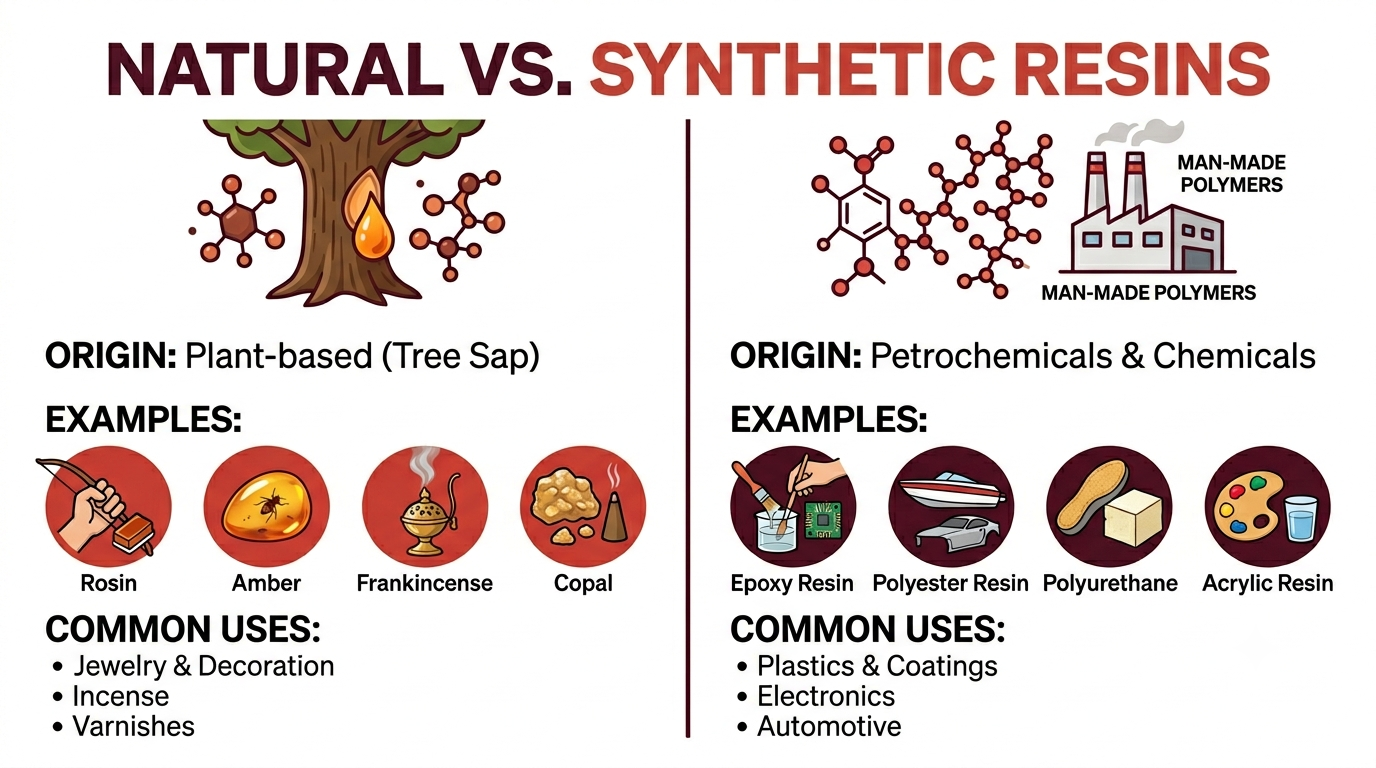
Resins fall into two broad families: natural resins that come from plants and trees, and synthetic resins that are manufactured. Here are the most common examples of each.
Natural Resins
- Rosin: usually found in pine trees. Used to make adhesives, varnishes, and grip for sports equipment.
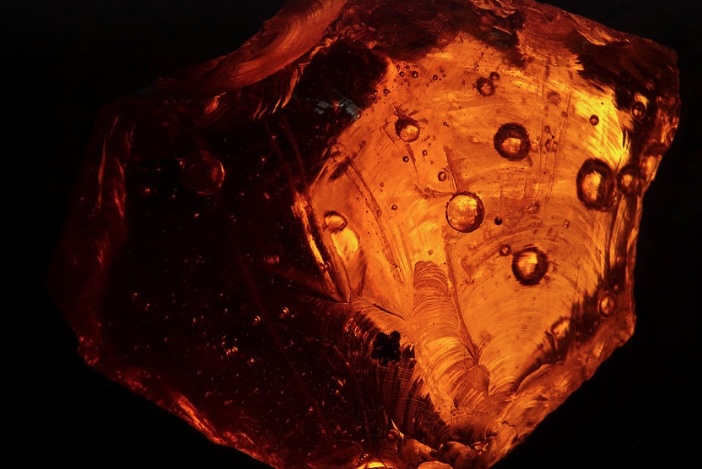
- Amber: fossilized resin from ancient trees, often used in jewelry. It is also the feature image for this article.
- Frankincense and Myrrh: come from tree sap and are often used in perfumes and incense.
- Copal: used in the production of varnishes and incense.
Synthetic Resins
Synthetic resins are man-made. They are produced through chemical reactions known as polymerization, and they are engineered to have specific properties for a wide range of industrial applications, from plastics to paints to adhesives to electronics.
- Epoxy Resin: a strong adhesive that resists heat and chemical exposure. A great option for coatings and adhesives.
- Polyester Resin: used in fiberglass, auto parts, and marine hulls.
- Polyurethane Resin: flexible and abrasion-resistant, which makes it ideal for coatings, footwear, and foam.
- Acrylic Resin: used in paint formulations, coatings, and acrylic glass.
Natural vs. Synthetic Resins
| Feature | Natural Resins | Synthetic Resins |
|---|---|---|
| Origin | Secreted by plants and trees | Manufactured from monomers |
| How it is made | Collected from trees, then cleaned or distilled | Created through polymerization, then modified with additives |
| Key traits | Sticky, viscous, hardens in air | Engineered for strength, heat resistance, and flexibility |
| Common examples | Rosin, amber, frankincense, copal | Epoxy, polyester, polyurethane, acrylic |
| Typical uses | Jewelry, incense, varnishes, adhesives | Plastics, coatings, electronics, automotive, medical |
Both play crucial roles. Natural resins remain valued for traditional and aesthetic uses, while synthetic resins drive modern manufacturing through tailored properties.
Historical Uses of Resins
Natural resin use appears throughout history, as far back as ancient civilizations. In Egypt, resins like myrrh and frankincense were used in religious ceremonies as incense and during mummification; ancient Egyptians valued myrrh for its preservative and aromatic qualities. In Greece and Rome, resins were used as adhesives and to waterproof ships, and Greeks prized natural resins in jewelry making. Some resins were even used to formulate the inks in historic manuscripts. In traditional Chinese medicine, frankincense was used to treat arthritis, heal wounds, and reduce inflammation.
Synthetic resin use began to flourish in the early 20th century with phenolic resins, invented by Leo Baekeland in 1907. This marked the start of the plastics industry and led to synthetic resins in countless applications. During both World Wars, demand for materials like rubber drove major advances in synthetic resins, especially for aircraft, vehicles, and clothing. After the wars, synthetic resins helped manufacture a wide array of household items, especially for the electronics industry, and later supported the medical field as well.
What Is Resin Made Of?
Natural resin is made of organic compounds the tree produces, mostly terpenes and resin acids. Synthetic resin is made of monomers, small molecules usually derived from petroleum, natural gas, or plant-based materials, that are chemically linked into polymers. Additives are then mixed in to fine-tune performance.
How Is Resin Made?
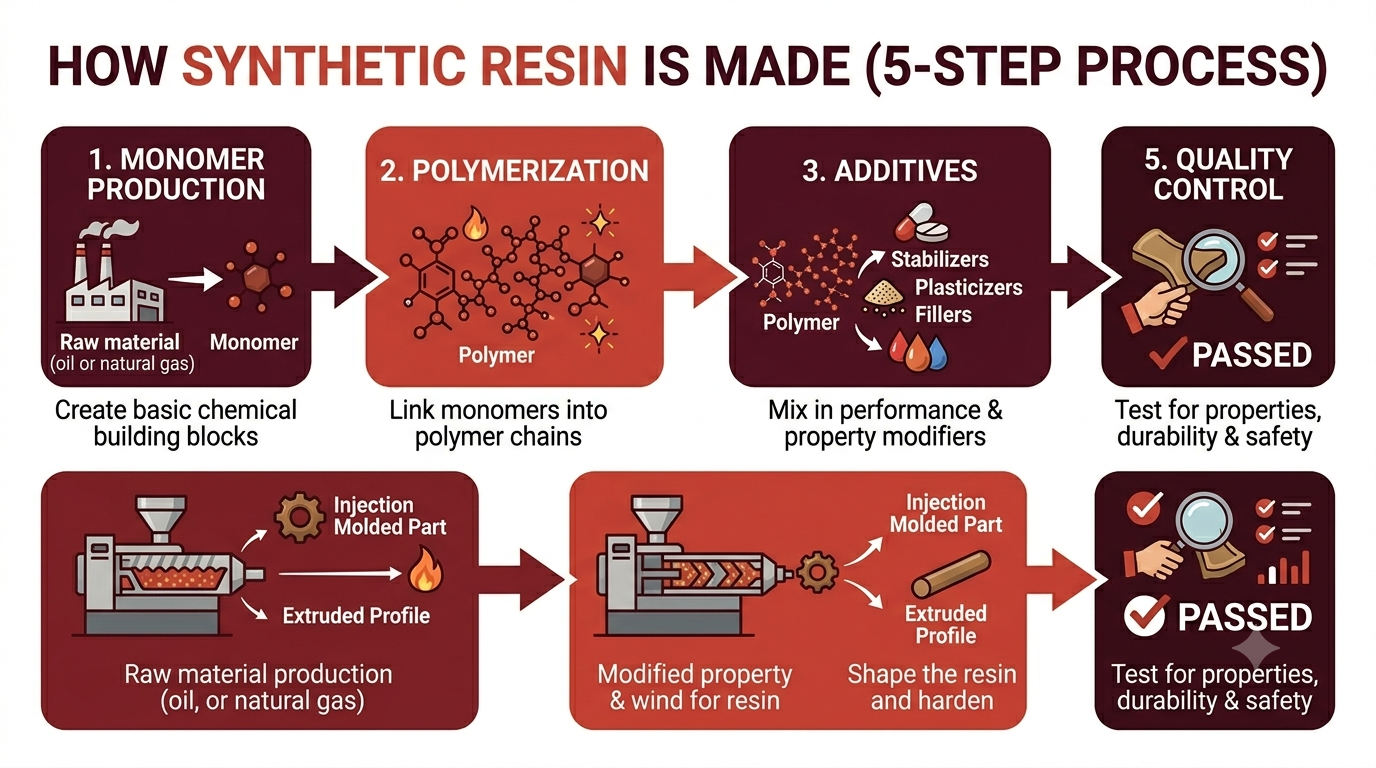
Natural resin is collected from trees and then cleaned or distilled. Synthetic resin is manufactured through polymerization: monomers are produced, linked into polymers, modified with additives, then formed and cured into a final shape.
Natural Resins
Natural resins are typically collected from trees. At a high level, an incision is made in the tree and the resin leaks out. Once collected, it may undergo different processing depending on its end use:
- Cleaning and purification: resins such as frankincense are cleaned of bark and leaf matter and may be graded on color and quality.
- Distillation: products like turpentine are derived from distilling pine resin.
Synthetic Resins
Manufacturing synthetic resins is a more involved chemical process, primarily polymerization. There are several ways to achieve it:
- Monomer production: monomers, the basic building blocks of polymers, are created. They are typically derived from petroleum, natural gas, and plant-based materials.
- Polymerization: monomers chemically react and link into polymer chains, usually driven by heat, light, or other catalysts.
- Modifications and additives: additives are mixed in to improve performance, durability, and processing, including stabilizers, plasticizers, and fillers.
- Forming and curing: the resin is molded into shape using techniques like injection molding, blow molding, and thermoforming.
- Quality control: finally, the resin is tested to ensure it meets quality and safety standards.
Where Is Resin Used?
Resin is used across construction, electronics, consumer goods, automotive, and medical applications, plus traditional uses like jewelry and incense.
In construction, synthetic resins like epoxy and polyurethane are vital for adhesives and sealants, and some resin-based foams provide acoustic insulation. In electronics, epoxy and silicone resins encapsulate and insulate components, protecting them from moisture, dust, and mechanical damage. In consumer goods, polyurethane and polyester resins show up in packaging, from flexible pouches to rigid containers. And amber and copal remain popular in jewelry.
The list of resin applications is nearly endless. Resins are all around us, helping make goods, products, and structures safer, more functional, and longer-lasting.
From Everyday Resins to Engineering Resins
Most of the resins above are general-purpose. The resins that power modern electronics, medical devices, and consumer products are a more specialized group called engineering resins. Polymer Resources is a specialty engineering resin compounder. To learn how engineering resins differ from commodity plastics, see our Introduction to Polymer Resins guide, or explore our resin products like ABS, polycarbonate (PC), nylon, and PBT.
Frequently Asked Questions
What is resin?
Resin is a viscous organic substance made of polymers, long chains of repeating molecules. It comes from natural sources (plants and trees) or is made synthetically through polymerization, and it hardens into a durable solid.
What is resin made of?
Natural resin is made of organic compounds like terpenes and resin acids. Synthetic resin is made of monomers, usually derived from petroleum, natural gas, or plant-based materials, that are linked into polymers and combined with additives.
How is resin made?
Natural resin is collected from trees, then cleaned or distilled. Synthetic resin is made through polymerization: producing monomers, linking them into polymers, adding additives, then forming and curing the result.
Where does resin come from?
Natural resin comes from plants and trees, which secrete it to protect wounds. Synthetic resin is manufactured from chemical building blocks.
What are the types of resin?
The two broad families are natural resins (rosin, amber, frankincense, copal) and synthetic resins (epoxy, polyester, polyurethane, acrylic).
Is resin natural or synthetic?
Both. Natural resins are secreted by plants and trees, while synthetic resins are man-made through polymerization. Most modern industrial resins are synthetic.