
by Todd Hotes | Nov 15, 2025 | Blog
When it comes to patient safety and device reliability, few people ever talk about the materials used to manufacture widely used non-invasive medical devices. But, they should. From diagnostic housings to reusable handles and even connectors, every component in a medical device needs to balance mechanical performance, biocompatibility and regulatory compliance. And all while meeting the design and sterilization demands prioritized in clinical environments.
While there are a number of engineering resins available, polyetherimide (PEI) and polyphenylene oxide (PPO) stand out for their exceptional strength, heat resistance, and stability. So we’re going to focus on those today.
As the medical industry continues to evolve towards safer, smarter, and more sustainable materials, choosing the right engineering resin becomes a critical decision. Understanding the distinct benefits of PEI and PPO and how they compare to other commonly used polymers goes a long ways in helping medical device engineers better design for safety and longevity, as well as compliance.
Let’s dig in.
Why PEI and PPO Are Ideal for Non-Invasive Medical Devices
Non-invasive medical devices have to do more than just function (though that’s important), they have to perform reliably, often under tough conditions. From frequent sterilization to exposure to harsh disinfectants, these products need materials that won’t crack, warp, or degrade over time. That’s where polyetherimide (PEI) and polyphenylene oxide (PPO) come in. Both offer a level of performance that goes beyond what’s possible with general-purpose plastics.
PEI is known for its ability to withstand high heat, maintaining its structure even during repeated autoclave sterilization. In case you’re curious, “autoclave sterilization” is a high temp, high pressure steam process used to kill bacteria, viruses, fungi, and spores. If materials are weak or questionable, such high heat can degrade the materials pretty fast.
PEi delivers the kind of dimensional stability and stiffness engineers count on when designing reusable components. Again, think heat.
PPO, on the other hand, brings excellent hydrolytic stability and chemical resistance. That makes it a strong choice for products exposed to moisture, cleaning solutions, and temperature changes.
Both PEI and PPO also maintain their form in humid environments (think steam again) and can be formulated to meet key medical standards like ISO 10993 or USP Class VI for biocompatibility. That means they’re safe for skin contact and patient handling which is essential for non-invasive devices used every day in clinical settings.
When compared to more common materials like polycarbonate (PC), acrylonitrile butadiene styrene (ABS), or polyvinyl chloride (PVC), PEI and PPO stand out. While those resins work well for lightweight housings or disposables, they tend to lose shape under high heat or after multiple sterilization cycles. PEI and PPO hold up longer, keeping their integrity and performance through repeated use.
For manufacturers looking for a balance of safety, durability, and design flexibility, these resins deliver by helping bridge the gap between standard thermoplastics and the high-performance demands of modern medical devices.
Key Applications in Non-Invasive Medical Devices
PEI and PPO resins aren’t just strong on paper, they prove their value in real-world medical settings every day.
Their ability to resist heat, chemicals, and wear makes them reliable choices for components that must perform consistently, even after repeated cleaning or sterilization.
Here are some of the most common areas where these materials stand out.
Diagnostic Equipment and Device Housings
From blood analyzers and patient monitoring systems to imaging units and centrifuge housings, non-invasive diagnostic equipment depends on materials that can handle constant use without losing dimensional accuracy. PEI and PPO provide the rigidity and thermal stability needed to protect sensitive electronics while keeping weight and manufacturing costs under control. Their smooth surface finishes also make them easier to clean, a key advantage in clinical environments where hygiene is non-negotiable.
Reusable Handles, Trays, and Connectors
For reusable surgical tools, autoclave trays, and instrument handles that undergo repeated sterilization, PEI is often the go-to choice.
It keeps its form and mechanical properties even after dozens of sterilization cycles. PPO also performs well in connectors, tube fittings, and ergonomic grips where moisture and repeated handling come into play.
Both materials can be custom-formulated to improve grip, color stability, or resistance to stress cracking.
Fluid Management and Delivery Systems
When it comes to non-implantable devices that move or manage fluids, like pumps, valves, or external delivery cartridges, PEI and PPO deliver consistent performance.
Their low moisture absorption helps maintain precision fit and function, while their chemical resistance protects against degradation from cleaning solutions or reagents.
These examples show why PEI and PPO resins have become dependable materials for engineers designing next-generation medical devices that prioritize safety, reliability, and longevity.
Design and Processing Considerations
Selecting the right resin is only part of the equation.
How it’s processed and designed into a device can make or break overall performance.
PEI and PPO both offer excellent processability for complex geometries, but there are a few considerations that medical device engineers should keep in mind to get the most out of these materials.
Moldability and Dimensional Precision
Can it shape? And stay that way?
PEI and PPO resins allow for tight tolerances and precise molding, which is critical when parts need to align perfectly in diagnostic systems or reusable tools. Their inherent stiffness helps prevent warping during cooling, while their low moisture absorption keeps dimensions stable after production. These traits make both materials ideal for components that require repeatable accuracy, such as instrument housings, pump components, and sensor enclosures.
Color Matching and Transparency Options
While performance often takes center stage, aesthetics matter too; especially in medical environments where color coding, clarity, and clean appearance all contribute to usability and brand consistency.
PEI offers natural transparency with a slight amber hue, while PPO can be easily pigmented for opaque or translucent applications.
Polymer Resources can custom-compound both materials to achieve the exact color, opacity, or finish required, without compromising performance or regulatory compliance.
Maintaining Compliance Through Processing
It’s important to note that not all grades of PEI or PPO are created equal.
Medical-grade formulations from suppliers like Polymer Resources are designed to meet FDA and ISO requirements, including biocompatibility and lot-to-lot consistency. Proper drying, controlled processing temperatures, and post-mold conditioning help ensure these resins retain their mechanical properties and compliance through every production cycle.
From design to manufacturing, the key takeaway is simple: when processed correctly, PEI and PPO resins deliver the dimensional accuracy, sterilization resistance, and clean aesthetics that non-invasive medical devices demand.
Sustainability and Supply Chain Reliability
Because both materials are reusable and recyclable, they help extend the lifespan of medical components and reduce the need for frequent replacements. Their ability to endure multiple sterilization cycles also supports sustainability by cutting down on disposable plastics. For OEMs pursuing eco-conscious product lines, this can translate into lower overall material consumption without compromising safety or compliance.
On the production side, Polymer Resources manufactures and compounds materials domestically, which helps reduce lead times and minimize the supply chain risks associated with overseas sourcing (particularly related to tariffs).
Consistent, U.S.-based production also ensures that each formulation maintains the same high quality and regulatory traceability, critical for customers operating in the medical sector.
With PEI and PPO, manufacturers can count on a reliable supply of medical-grade resin solutions that perform, comply, and align with long-term sustainability goals.
Partnering with Polymer Resources
Selecting the right resin for a non-invasive medical device is about more than performance; it’s about trust.
Polymer Resources partners with medical manufacturers to deliver custom PEI and PPO formulations that meet strict standards for sterilization, strength, and biocompatibility.
Our U.S.-based team provides consistent, medical-grade compounding with precise color matching, transparency options, and regulatory documentation. From material selection to processing support, we help engineers design safer, smarter, and more sustainable devices with confidence.
Contact us today.
by Todd Hotes | Oct 2, 2025 | Blog
When you are choosing a material for tough, high-impact applications, polycarbonate is often at the top of the list.
It is strong, lightweight, and versatile, making it a go-to option in industries ranging from medical devices to construction.
Two of the biggest brand names in polycarbonate are Makrolon and LEXAN. Both are well known, and both have built solid reputations for performance. But they’re not the only choices out there.
At Polymer Resources, we offer reliable, U.S.-based polycarbonate options that deliver the same impact strength and durability without the supply chain headaches or premium price tag that can come with major brands.
What is Polycarbonate?
Polycarbonate is a type of plastic that stands out because it’s tough yet lightweight. Imagine something as clear as glass, but far more durable; that’s polycarbonate. It can handle strong impacts without breaking, which makes it useful in all kinds of industries.
You’ll find polycarbonate in everyday items like safety glasses, medical devices, building materials, and even electrical components. Its ability to resist impact, stay clear, and handle heat makes it a favorite when strength and safety matter most.
Both Makrolon and LEXAN are simply brand names of this versatile material. Let’s explore this extraordinary material in more detail.
Makrolon and LEXAN: The Big Names
When people talk about polycarbonate, two names often come up first: Makrolon and LEXAN.
And that’s fair.
These brands have been around for decades and have earned a strong reputation in industries where performance can’t be compromised.
- Makrolon is widely recognized for its durability and excellent optical clarity, making it a popular choice for applications where visibility and strength go hand in hand.
- LEXAN is known for its toughness and versatility. It’s often used in demanding environments where impact resistance and reliability are essential.
Even though they come from different manufacturers, both Makrolon and LEXAN are simply variations of the same material: polycarbonate. Their popularity comes down to trusted performance, wide availability, and long histories in the marketplace.
In other words, they’re both outstanding options.
Key Differences Between Makrolon and LEXAN
While both Makrolon and LEXAN are polycarbonate, there are a few subtle differences worth noting:
- Impact Strength: Both are highly impact-resistant, though certain Makrolon grades are often highlighted for extra toughness.
- Optical Clarity: Makrolon is commonly chosen for applications needing clear, glass-like transparency, while LEXAN is more widely used where clarity isn’t the top priority. Source > Covestro AG
- Heat Resistance: Performance is similar, though grade variations can shift the balance slightly depending on application. Source > Covestro AG
- Cost & Availability: Prices can fluctuate between the two brands, and availability may depend on regional supply chains.
In practice, the differences aren’t dramatic, both materials are trusted for high-impact, high-performance applications.
Why Consider Alternatives?
Makrolon and LEXAN have strong reputations, but relying only on big-name brands can sometimes come with challenges.
Prices may swing depending on global supply and demand, and long lead times can slow down projects. For manufacturers working on tight schedules and budgets, that can create real headaches.
Another challenge with global suppliers can be high minimum order quantities. For example, customers buying LEXAN from SABIC may face large MOQs or be pushed toward premium, higher-cost grades just to secure smaller lots.
That’s where alternatives come in. Choosing a reliable, domestic supplier gives you more control. You can count on consistent availability, avoid supply chain bottlenecks, and often save on costs without sacrificing performance.
At the end of the day, what matters most is getting material that performs the way you need it to without the added stress of unpredictable pricing or delayed shipments.
Polymer Resources’ Polycarbonate Solutions
At Polymer Resources, we understand that manufacturers need more than just a material, they need a partner they can rely on.
That’s why our polycarbonate resins are designed to deliver the same high-impact performance you’d expect from Makrolon or LEXAN, but with the added benefits of a domestic, dependable supply chain.
Here’s what sets us apart:
- Consistent Availability – U.S.-based supply means shorter lead times and fewer disruptions.
- Custom Formulations – Tailored solutions for unique applications, plus full color matching capabilities.
- Minimum Order Quantity – Smaller custom compounded lots as low as 250lb (with fully compounded color)
- High-Impact Performance – Toughness and durability on par with the big brands.
- Cost-Effective – Competitive pricing without sacrificing quality.
- Technical Support – Our experts help guide material selection and processing so you get the best fit every time.
With Polymer Resources, you get the performance your application demands and the reliability your business depends on.
FAQ: Polycarbonate Choices for High-Impact Applications
Are Makrolon and LEXAN different materials?
No, both are brand names for polycarbonate. While each brand has its own product grades and strengths, they’re both built on the same tough, impact-resistant plastic.
Why would a company consider alternatives to Makrolon or LEXAN?
Executives often look for alternatives when facing supply chain delays, cost fluctuations, flexible order quantities, or limited availability. A domestic supplier like Polymer Resources helps reduce risk while maintaining performance standards.
Can Polymer Resources’ polycarbonate really match the performance of big-name brands?
Yes. PRL’s polycarbonate resins are designed for the same impact strength, durability, and versatility as leading brands, with the added advantage of local support and consistent supply.
What industries benefit most from PRL’s polycarbonate solutions?
We serve industries where safety, reliability, and performance are critical: medical devices, building & construction, electrical, and consumer goods.
How does PRL support companies beyond just supplying material?
Polymer Resources goes beyond selling resin by offering custom formulations, color matching, regulatory compliance expertise, flexible order quantities, and technical consulting, helping businesses find the right fit for their exact application.
What’s the biggest advantage for executives choosing PRL over global brands?
It comes down to control and reliability. By working with a U.S.-based supplier, companies avoid costly delays, stabilize budgets, and gain a partner who can adapt solutions to their needs.
by Todd Hotes | Dec 7, 2024 | Blog
When it comes to high-impact applications, a surface-level understanding of resin properties isn’t enough. Selecting the ideal material is a strategic process, requiring alignment between resin capabilities and the unique demands of the application.
This blog delves into these challenges and highlights how innovative resin solutions are paving the way for next-level performance.
(more…)

by Todd Hotes | Sep 14, 2024 | Blog
Choosing the right resin is essential because different resins affect a product’s performance, durability, and longevity.
In this blog, we’re focusing on three primary resins: Polycarbonate (PC), Acrylonitrile Butadiene Styrene (ABS), and Acrylonitrile Styrene Acrylate (ASA).
Each of these resins offers unique properties with their own pros and cons. Choosing the wrong resin can lead to issues such as poor weather resistance, decreased longevity, and even total failure. That’s why it’s important to understand the distinct advantages and limitations of each resin so you can make an informed decision. Ultimately, choosing the right resin can save you time and money in the long run.
(more…)
by Todd Hotes | May 10, 2024 | Blog
There are two main types of resins: natural and synthetic. Both have a rich history. And while we focus on polymer resins here, we feel it’s important to educate across both types so we all better grasp the concepts from a general perspective. Let’s start with a quick definition, then a little history.
What Is Resin?
Resin is a viscous organic substance made up of polymers, which are long, repeating chains of molecules. It comes from two sources: natural resins, secreted by plants and trees, and synthetic resins, made through a chemical process called polymerization. Once hardened, resin becomes a durable solid used in everything from jewelry to electronics.
Resins are complex organic substances composed mainly of liquids or solids that we derive from plants or produce in labs. They are made up of a network of molecules known as polymers. Let’s break down both natural and synthetic resins.
Natural resins are, as you might expect, secreted by plants and most often trees. Often these resins help the tree protect itself from injury. When a tree is wounded, it releases resin to seal the wound and guard against insects or fungus that might invade and eventually destroy the tree.
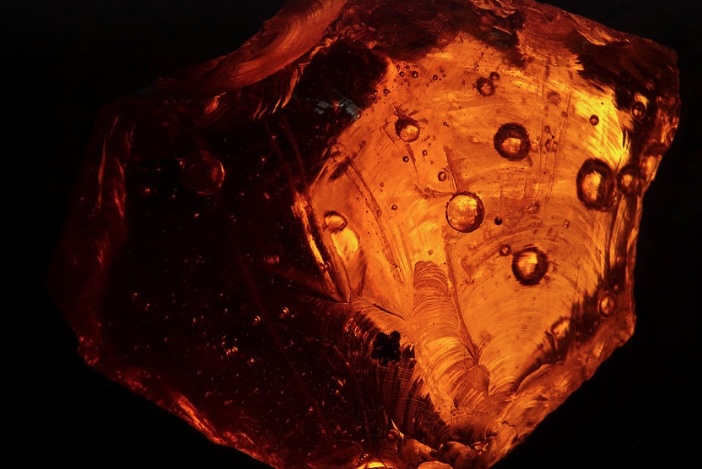
Over time, resins harden into substances such as amber. A natural resin is often sticky and viscous, and it typically hardens as it is exposed to air.
What Are the Types of Resin?
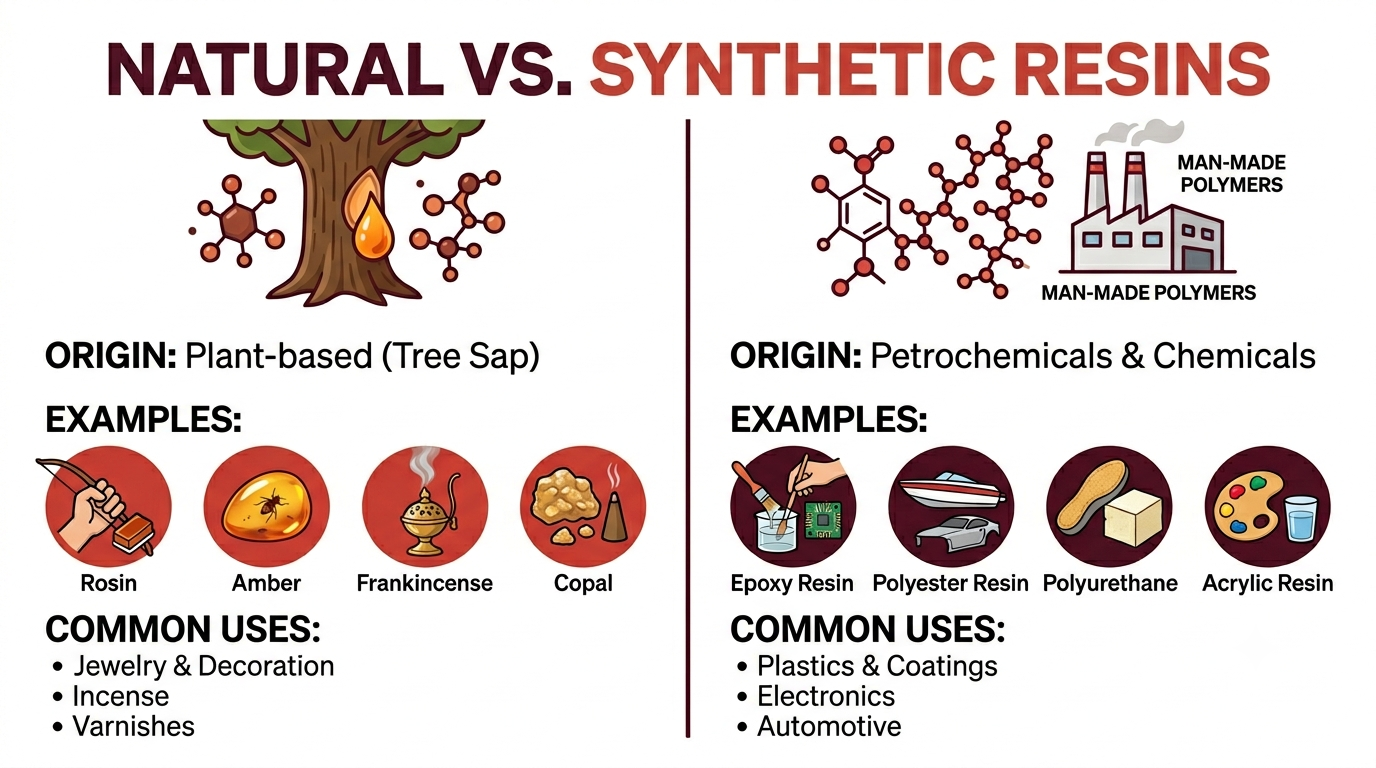
Resins fall into two broad families: natural resins that come from plants and trees, and synthetic resins that are manufactured. Here are the most common examples of each.
Natural Resins
- Rosin: usually found in pine trees. Used to make adhesives, varnishes, and grip for sports equipment.
- Amber: fossilized resin from ancient trees, often used in jewelry. It is also the feature image for this article.
- Frankincense and Myrrh: come from tree sap and are often used in perfumes and incense.
- Copal: used in the production of varnishes and incense.
Synthetic Resins
Synthetic resins are man-made. They are produced through chemical reactions known as polymerization, and they are engineered to have specific properties for a wide range of industrial applications, from plastics to paints to adhesives to electronics.
- Epoxy Resin: a strong adhesive that resists heat and chemical exposure. A great option for coatings and adhesives.
- Polyester Resin: used in fiberglass, auto parts, and marine hulls.
- Polyurethane Resin: flexible and abrasion-resistant, which makes it ideal for coatings, footwear, and foam.
- Acrylic Resin: used in paint formulations, coatings, and acrylic glass.
Natural vs. Synthetic Resins
| Feature |
Natural Resins |
Synthetic Resins |
| Origin |
Secreted by plants and trees |
Manufactured from monomers |
| How it is made |
Collected from trees, then cleaned or distilled |
Created through polymerization, then modified with additives |
| Key traits |
Sticky, viscous, hardens in air |
Engineered for strength, heat resistance, and flexibility |
| Common examples |
Rosin, amber, frankincense, copal |
Epoxy, polyester, polyurethane, acrylic |
| Typical uses |
Jewelry, incense, varnishes, adhesives |
Plastics, coatings, electronics, automotive, medical |
Both play crucial roles. Natural resins remain valued for traditional and aesthetic uses, while synthetic resins drive modern manufacturing through tailored properties.
Historical Uses of Resins
Natural resin use appears throughout history, as far back as ancient civilizations. In Egypt, resins like myrrh and frankincense were used in religious ceremonies as incense and during mummification; ancient Egyptians valued myrrh for its preservative and aromatic qualities. In Greece and Rome, resins were used as adhesives and to waterproof ships, and Greeks prized natural resins in jewelry making. Some resins were even used to formulate the inks in historic manuscripts. In traditional Chinese medicine, frankincense was used to treat arthritis, heal wounds, and reduce inflammation.
Synthetic resin use began to flourish in the early 20th century with phenolic resins, invented by Leo Baekeland in 1907. This marked the start of the plastics industry and led to synthetic resins in countless applications. During both World Wars, demand for materials like rubber drove major advances in synthetic resins, especially for aircraft, vehicles, and clothing. After the wars, synthetic resins helped manufacture a wide array of household items, especially for the electronics industry, and later supported the medical field as well.
What Is Resin Made Of?
Natural resin is made of organic compounds the tree produces, mostly terpenes and resin acids. Synthetic resin is made of monomers, small molecules usually derived from petroleum, natural gas, or plant-based materials, that are chemically linked into polymers. Additives are then mixed in to fine-tune performance.
How Is Resin Made?
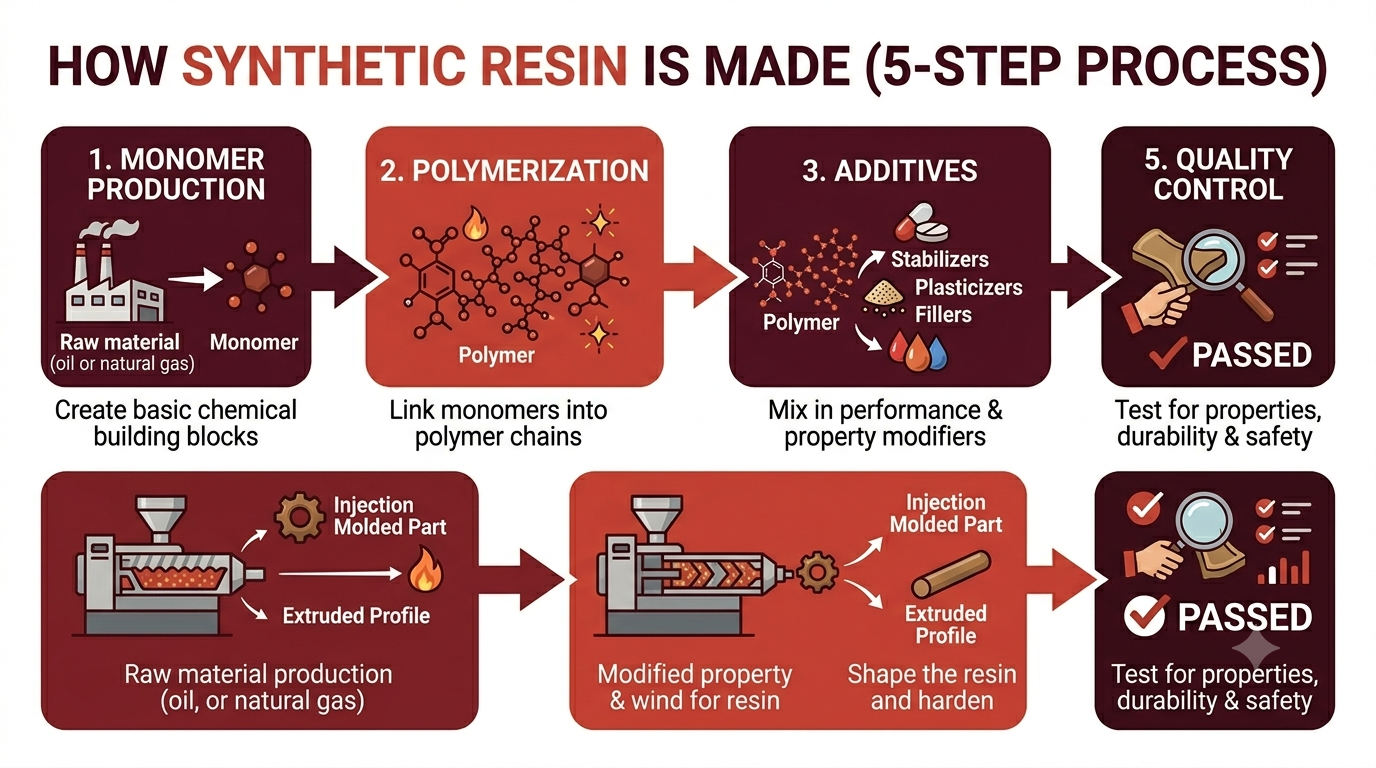
Natural resin is collected from trees and then cleaned or distilled. Synthetic resin is manufactured through polymerization: monomers are produced, linked into polymers, modified with additives, then formed and cured into a final shape.
Natural Resins
Natural resins are typically collected from trees. At a high level, an incision is made in the tree and the resin leaks out. Once collected, it may undergo different processing depending on its end use:
- Cleaning and purification: resins such as frankincense are cleaned of bark and leaf matter and may be graded on color and quality.
- Distillation: products like turpentine are derived from distilling pine resin.
Synthetic Resins
Manufacturing synthetic resins is a more involved chemical process, primarily polymerization. There are several ways to achieve it:
- Monomer production: monomers, the basic building blocks of polymers, are created. They are typically derived from petroleum, natural gas, and plant-based materials.
- Polymerization: monomers chemically react and link into polymer chains, usually driven by heat, light, or other catalysts.
- Modifications and additives: additives are mixed in to improve performance, durability, and processing, including stabilizers, plasticizers, and fillers.
- Forming and curing: the resin is molded into shape using techniques like injection molding, blow molding, and thermoforming.
- Quality control: finally, the resin is tested to ensure it meets quality and safety standards.
Where Is Resin Used?
Resin is used across construction, electronics, consumer goods, automotive, and medical applications, plus traditional uses like jewelry and incense.
In construction, synthetic resins like epoxy and polyurethane are vital for adhesives and sealants, and some resin-based foams provide acoustic insulation. In electronics, epoxy and silicone resins encapsulate and insulate components, protecting them from moisture, dust, and mechanical damage. In consumer goods, polyurethane and polyester resins show up in packaging, from flexible pouches to rigid containers. And amber and copal remain popular in jewelry.
The list of resin applications is nearly endless. Resins are all around us, helping make goods, products, and structures safer, more functional, and longer-lasting.
From Everyday Resins to Engineering Resins
Most of the resins above are general-purpose. The resins that power modern electronics, medical devices, and consumer products are a more specialized group called engineering resins. Polymer Resources is a specialty engineering resin compounder. To learn how engineering resins differ from commodity plastics, see our Introduction to Polymer Resins guide, or explore our resin products like ABS, polycarbonate (PC), nylon, and PBT.
Frequently Asked Questions
What is resin?
Resin is a viscous organic substance made of polymers, long chains of repeating molecules. It comes from natural sources (plants and trees) or is made synthetically through polymerization, and it hardens into a durable solid.
What is resin made of?
Natural resin is made of organic compounds like terpenes and resin acids. Synthetic resin is made of monomers, usually derived from petroleum, natural gas, or plant-based materials, that are linked into polymers and combined with additives.
How is resin made?
Natural resin is collected from trees, then cleaned or distilled. Synthetic resin is made through polymerization: producing monomers, linking them into polymers, adding additives, then forming and curing the result.
Where does resin come from?
Natural resin comes from plants and trees, which secrete it to protect wounds. Synthetic resin is manufactured from chemical building blocks.
What are the types of resin?
The two broad families are natural resins (rosin, amber, frankincense, copal) and synthetic resins (epoxy, polyester, polyurethane, acrylic).
Is resin natural or synthetic?
Both. Natural resins are secreted by plants and trees, while synthetic resins are man-made through polymerization. Most modern industrial resins are synthetic.